


How Enterprise App Development Services Drive Operational Efficiency
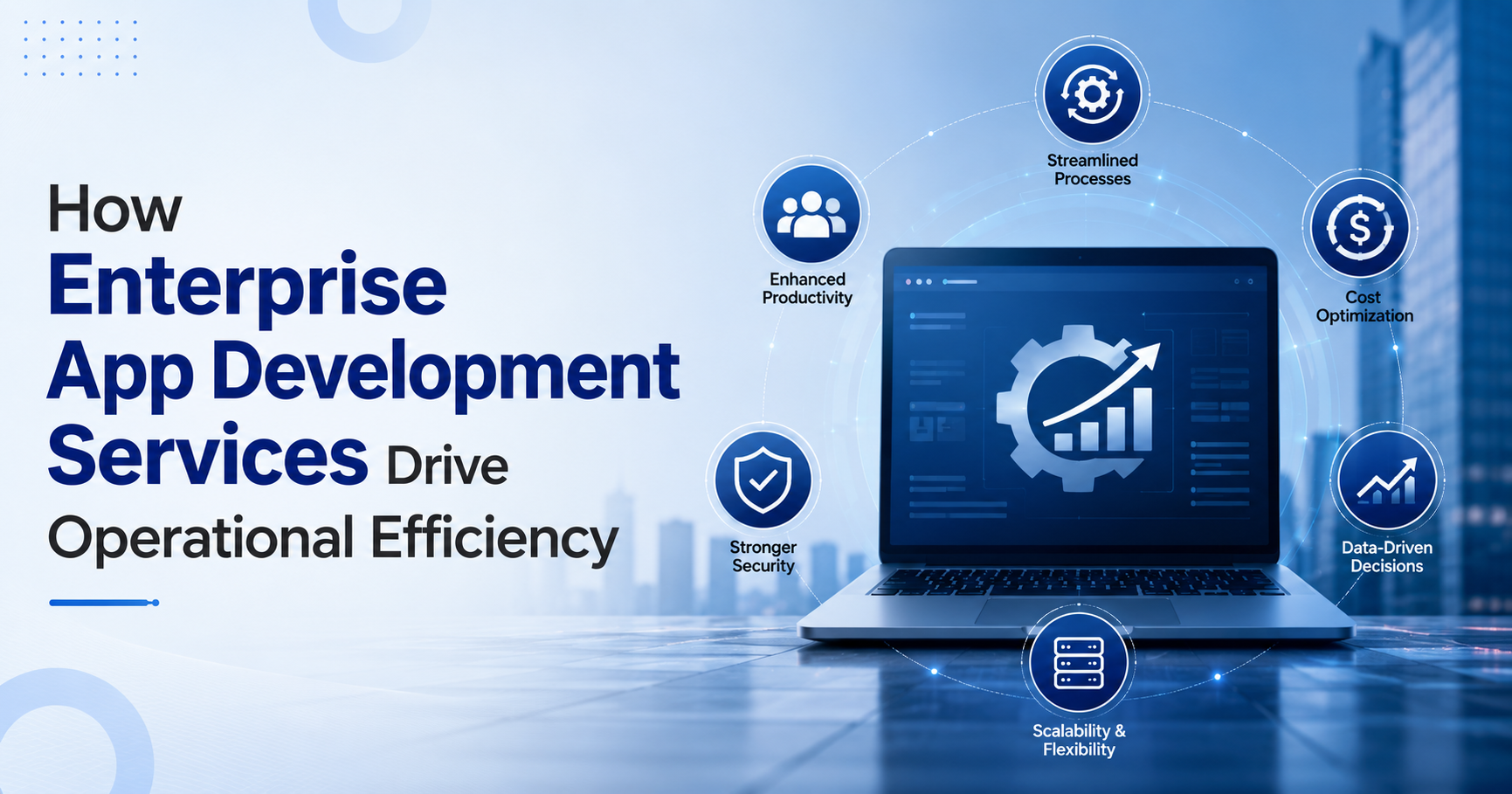
Running a business at scale is no longer just about having a great product or a large team — it is about how intelligently your internal systems work together. From supply chain coordination to customer engagement, the invisible backbone of modern enterprises is software. Yet many business owners still rely on a patchwork of generic tools, spreadsheets, and disconnected platforms that quietly drain productivity every single day. The hidden costs of operational inefficiency — delayed decisions, duplicated workflows, communication gaps — compound faster than most leaders realize. This is precisely where investing in enterprise app development services becomes not just a technology decision, but a strategic business imperative.
Custom-built enterprise applications are engineered around the specific DNA of your business. They eliminate the inefficiencies baked into off-the-shelf software and give your teams tools that actually fit the way they work. The result is faster execution, fewer errors, and a measurable uplift in output across every department.
The Real Cost of Operational Inefficiency in Large Organizations
Before exploring solutions, it is worth understanding the problem at its root. Operational inefficiency does not always announce itself dramatically — it shows up subtly in the form of employees toggling between five different software platforms, managers waiting days for reports, or customer queries falling through the cracks of a non-integrated CRM. For enterprises operating across departments, geographies, or multiple product lines, these small friction points snowball into significant losses. Research consistently shows that businesses lose anywhere from 20 to 30 percent of their annual revenue due to operational inefficiencies. When you factor in the cost of manual data entry errors, redundant processes, and slow response times, the financial case for smarter systems becomes undeniable.
The challenge for most enterprises is not a lack of effort but a lack of cohesion. Departments work in silos, software tools do not talk to each other, and real-time data visibility remains a privilege of only the most tech-forward companies. Partnering with an experienced enterprise app development company changes this equation fundamentally by replacing fragmented systems with purpose-built solutions designed for cross-functional coordination.
Common operational inefficiencies that custom enterprise apps directly address:
- Manual data entry across disconnected platforms leading to version control nightmares and costly errors
- Approval workflows that rely on email chains, causing delays in critical decision-making
- Lack of real-time visibility into inventory, workforce, or financial performance
- Customer service bottlenecks due to siloed CRM and support systems
- Reporting that requires manual compilation instead of automated, live dashboards
Why Generic Software Falls Short at the Enterprise Level
Off-the-shelf software is built to serve the broadest possible audience, which means it is designed around average use cases — not yours. For small businesses, this trade-off is often acceptable. But for enterprises with complex hierarchies, regulatory requirements, multi-location operations, and thousands of daily transactions, generic tools simply cannot keep up. The more a business grows, the more painfully obvious the gaps become. You end up paying for features you do not need, while missing the specific functionality that would actually move the needle for your organization.
A qualified enterprise software development company builds applications that map precisely to your existing workflows — and more importantly, to the workflows you aspire to have. Rather than forcing your teams to adapt to software limitations, the software adapts to your business logic, compliance demands, and scalability targets. This distinction alone can represent millions of dollars in recovered productivity over a three-to-five year horizon.
Key limitations of off-the-shelf enterprise software that custom development overcomes:
- Inability to integrate seamlessly with legacy systems already embedded in enterprise infrastructure
- Rigid pricing models that scale costs linearly with users, regardless of actual value delivered
- Limited customization options that prevent alignment with unique business processes
- Vendor dependency and lack of ownership over critical business logic and data
- Compliance gaps in industries with strict data governance or regulatory frameworks
Mobile-First Enterprise: The Role of Enterprise Mobile App Development Services
The workforce is no longer desk-bound. Field agents, remote teams, warehouse supervisors, and sales representatives all need real-time access to business systems from wherever they are. This shift has made mobile capability a critical dimension of operational efficiency — not a luxury add-on. When employees cannot access the right information at the right time because they are away from a desktop, decisions slow down, errors multiply, and customer experience suffers. Enterprise mobile app development services exist specifically to bridge this gap, extending the power of enterprise systems to mobile devices without compromising security or performance.
The best enterprise mobile app development company does not just build apps that look good on phones — they engineer mobile ecosystems that integrate deeply with ERP systems, CRMs, IoT devices, and back-end databases. Whether it is a logistics company enabling real-time tracking for drivers, a healthcare provider giving clinicians instant access to patient records, or a manufacturing firm allowing floor supervisors to approve work orders on the go, mobile enterprise apps are redefining how operational efficiency is achieved in the field.
Business benefits delivered by enterprise mobile applications:
- Real-time data access for field teams, reducing turnaround time on approvals and decision-making
- Automated task assignment and progress tracking for distributed workforces
- Offline functionality ensuring uninterrupted operations even in low-connectivity environments
- Push notifications and alerts that keep critical stakeholders informed without manual follow-up
- Biometric authentication and encrypted data transmission for enterprise-grade mobile security
How Enterprise Software Development Services Streamline Core Business Operations
Operational efficiency is not achieved through a single application — it is the cumulative result of every system in your business talking to every other system without friction. This is the fundamental value that comprehensive enterprise software development services deliver. When your HR software feeds seamlessly into payroll, your inventory system triggers purchase orders automatically, and your sales CRM updates finance dashboards in real time, the entire organization operates with a speed and precision that is simply impossible to achieve otherwise. Each integrated system reduces the number of manual touchpoints, and each manual touchpoint eliminated is a potential error, delay, or compliance risk removed from the equation.
What truly separates a strategic software development engagement from a transactional one is the depth of process understanding a development partner brings to the table. The right enterprise app development services provider begins by mapping your operational workflows end to end, identifying redundancies and bottlenecks before a single line of code is written. This consultative approach ensures that the technology built actually solves the business problem at its source, rather than adding another layer of complexity on top of an already strained system.
Operational domains where enterprise software development drives measurable efficiency gains:
- Supply chain and inventory management — automated reordering, vendor tracking, and demand forecasting
- Human resources — onboarding automation, performance management, and compliance reporting
- Finance and accounting — real-time reconciliation, automated invoicing, and audit-ready reporting
- Customer relationship management — unified customer data, intelligent follow-up workflows, and churn prediction
- Project and resource management — capacity planning, milestone tracking, and cross-department collaboration
Choosing the Right Enterprise App Development Company: What to Look For
Not all development partners are built for enterprise-scale complexity. Selecting the wrong one can be as damaging as not investing in custom software at all — you end up with a half-built product, cost overruns, and a technology gap that is harder to close than when you started. As a business owner, your evaluation of a prospective enterprise app development company should go well beyond their portfolio of completed apps. You need a partner who understands your industry dynamics, has experience navigating enterprise integration complexity, and operates with the governance and transparency that large-scale projects demand.
Look for a development partner who brings together business analysts, UX strategists, security architects, and cloud engineers under one roof. The most impactful enterprise software development company engagements are collaborative by design — your internal stakeholders should be active participants in the product development process, not passive recipients of a finished deliverable. Agile delivery models, transparent sprint reviews, and clear escalation protocols are non-negotiable at this scale.
Evaluation criteria for selecting the right enterprise development partner:
- Proven experience in your specific industry vertical, with references from enterprise-scale clients
- Full-stack capability spanning mobile, web, cloud infrastructure, and legacy system integration
- Robust security practices including data encryption, penetration testing, and compliance readiness
- Transparent project management with dedicated communication channels and milestone accountability
- Post-launch support and SLA commitments that reflect the criticality of enterprise systems
The ROI Conversation: Quantifying Efficiency Through Custom Software
One question every business owner asks before committing to a custom development investment is straightforward: what is the return? The answer, when approached rigorously, is usually compelling. The ROI of enterprise application development is not limited to direct cost savings — though those are often substantial. It encompasses faster time-to-market, increased employee throughput, reduced error-related costs, improved customer retention, and the strategic advantage of data visibility that competitors without custom systems simply cannot match. When a logistics company reduces manual dispatch coordination time by 60 percent, or a retail enterprise eliminates stock discrepancies through real-time inventory sync, the financial impact materializes quickly and compounds over time.
It is also worth noting that the cost of inaction carries its own ROI — a negative one. Every month a business operates on inefficient, fragmented systems is a month of competitive ground lost, employee morale eroded by poor tools, and customers underserved by slow internal processes. Forward-thinking business owners frame the investment in enterprise mobile app development services not as an expense but as an operational infrastructure upgrade — one that pays dividends across every function of the business.
Measurable ROI indicators to track after enterprise app deployment:
- Reduction in time spent on manual data entry and cross-system reconciliation tasks
- Decrease in operational errors and associated rework or customer complaint resolution costs
- Improvement in employee productivity metrics tied to streamlined workflows and reduced tool switching
- Increase in customer satisfaction scores driven by faster response times and service consistency
- Reduction in IT maintenance overhead as legacy systems are replaced with modern, integrated applications
Final Thought: Efficiency Is a System, Not a Shortcut
Operational efficiency at the enterprise level is not achieved through hustle or headcount — it is engineered through systems that are deliberately designed to eliminate friction at every layer of your business. The companies that will lead their industries in the next decade are those investing now in technology infrastructure that makes execution faster, decisions smarter, and teams more capable. Whether you need a platform to unify your operations, a mobile solution for your field workforce, or a complete digital transformation of your core business processes, the right development partner makes all the difference.
The path forward is clear: evaluate your current operational pain points honestly, identify the workflows that are costing you time and money, and engage with a proven enterprise app development company that can translate those insights into software that moves your business forward. Operational efficiency is not a destination — it is a capability you build, system by system, process by process. And it starts with making the right technology decisions today.

 English
 Arabic
 French
 Spanish
 Portuguese
 Turkish
 Dutch
Dutch
 Italiano
 Russian
 Romaian
 Portuguese (Brazil)
 Greek
Greek