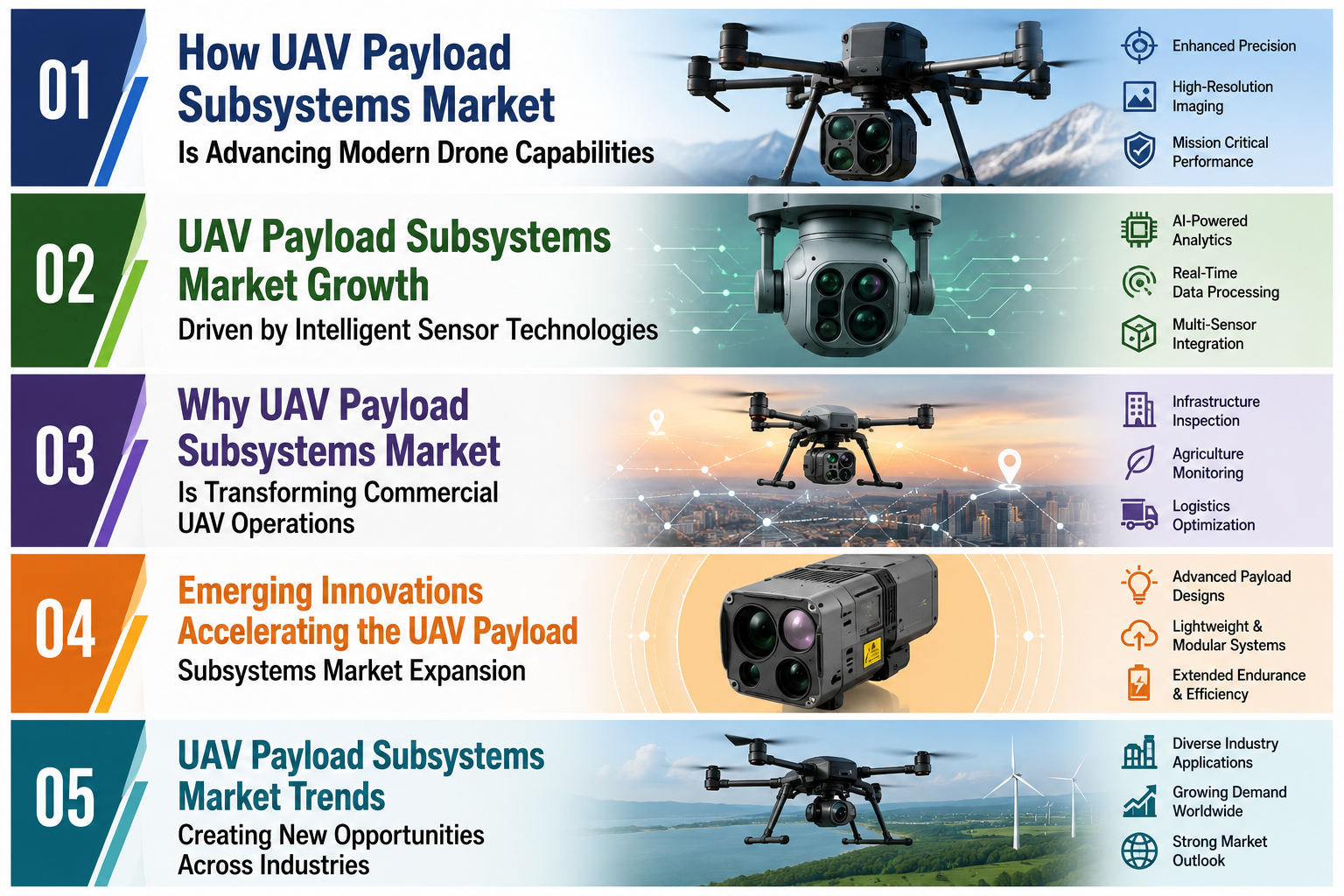
The UAV Payload Subsystems Market continues to gain momentum as organizations across various industries adopt unmanned aerial vehicles for increasingly specialized operations. Payload subsystems determine the functional capabilities of drones by integrating technologies such as high-resolution cameras, multispectral sensors, radar systems, communication equipment, laser scanners, and intelligent processing units. These advanced payloads enable UAVs to perform precision missions while improving operational efficiency, safety, and data accuracy.
As per Market Research Future, the growing need for autonomous aerial solutions is encouraging manufacturers to develop smarter, lighter, and more versatile payload technologies. Advances in artificial intelligence, sensor fusion, onboard computing, and wireless communication are allowing payload systems to deliver faster and more reliable results across commercial and defense applications.
One of the emerging opportunities supporting market growth is the increasing relevance of the Geospatial Analytics Market. UAV payload subsystems generate enormous volumes of spatial data that can be transformed into actionable insights through advanced geospatial analytics. Businesses use these analytical capabilities to improve land surveying, infrastructure planning, precision agriculture, environmental monitoring, mining exploration, and urban development. By combining aerial imagery with location-based intelligence, organizations can make informed decisions while improving operational efficiency and reducing project risks.
The agriculture industry continues expanding its investment in UAV payload systems equipped with multispectral and hyperspectral imaging technologies. These payloads enable farmers to monitor crop health, identify nutrient deficiencies, evaluate irrigation efficiency, and detect pest infestations before they become widespread. Accurate aerial analysis helps maximize productivity while reducing unnecessary resource consumption.
Construction companies are increasingly using UAV payload technologies to generate three-dimensional site models, monitor project progress, and inspect completed structures. These capabilities improve project planning, reduce manual surveying requirements, and provide stakeholders with accurate visual updates throughout the construction lifecycle.
The mining sector relies on advanced payload systems for geological mapping, stockpile measurement, environmental compliance, and operational planning. UAV-generated spatial data supports efficient resource management while minimizing safety risks associated with traditional surveying methods.
Environmental organizations also utilize UAV payload technologies to monitor forests, wetlands, wildlife habitats, and coastal ecosystems. High-resolution sensors allow researchers to track environmental changes, evaluate ecosystem health, and support conservation initiatives with reliable aerial intelligence.
Artificial intelligence is revolutionizing payload subsystem functionality by enabling automatic image classification, anomaly detection, predictive analytics, and autonomous mission management. Intelligent payload systems process data in real time, allowing operators to make faster and more informed decisions without extensive post-flight analysis.
Manufacturers continue improving payload miniaturization, battery efficiency, onboard computing performance, and modular system compatibility. These innovations increase UAV versatility while allowing a single platform to perform multiple specialized missions by simply changing payload configurations.
As demand for high-quality aerial intelligence continues to grow, payload subsystems will remain the foundation of UAV innovation. Their ability to support advanced sensing, intelligent analytics, and autonomous operations ensures strong commercial adoption across industries seeking efficient, data-driven solutions.
FAQs
Q1. What are geospatial analytics in UAV applications?
Geospatial analytics involves analyzing location-based aerial data collected by UAV payload systems to support surveying, mapping, environmental monitoring, construction planning, and infrastructure management.
Q2. Why are payload subsystems essential for UAV performance?
Payload subsystems determine the drone's operational capabilities by enabling functions such as imaging, sensing, mapping, communication, surveillance, and real-time data collection across diverse industries.




 English
 Arabic
 French
 Spanish
 Portuguese
 Deutsch
 Turkish
 Italiano
 Russian
 Romaian
 Portuguese (Brazil)
 Greek
Greek